Please Note That The Answers On This Page Are Based On The Last 100 Draws If Not Other.
Application Of Analog Signal. Applications with extensive signal processing on the digital side or complicated control sequences would require a large chip area, if. Analog and digital signal basics, uses in electronics, advantages and disadvantages with each technology, and other knowledge to help you this article discusses the corresponding characteristics, uses, advantages and disadvantages, and typical applications of analog vs. Analogue signals are transmitted using a continuously changing quantity as a reference. Data transmission consists of sending signals as continuous waves. Which varies in terms of its volume or power (amplitude) and its pitch or tone (frequency)? While talking of analog signal we describe the behaviour of the wave in respect of amplitude, period or frequency, and phase of the wave. They are capable of outputting continuous information with a we have seen analog signals in use in nearly every type of signal processing and consumer electronics application imaginable. Analogous variations in electrical or radio waves are created in order to transmit the. An anlaog signal is further classified into simple and composite signals. 4 comparison of analog vs digital quality. In both these technologies, the information, such as any audio or video, is transformed into electric signals. Analog is best explained by the transmission of signal such as sound or human speech, over an electrified copper wire. Analog signal is a kind of continuous wave form that changes over time. For example, in an analog audio signal. Analog and digital signals are used to transmit information, usually through electric signals.
Application Of Analog Signal - Modulation, Analog Modulation, Digital Modulation, Am,Fm ...
Radiation Hardened Analog Signal Processing Solutions .... Analog signal is a kind of continuous wave form that changes over time. An anlaog signal is further classified into simple and composite signals. Analog and digital signal basics, uses in electronics, advantages and disadvantages with each technology, and other knowledge to help you this article discusses the corresponding characteristics, uses, advantages and disadvantages, and typical applications of analog vs. Analogous variations in electrical or radio waves are created in order to transmit the. Analogue signals are transmitted using a continuously changing quantity as a reference. Applications with extensive signal processing on the digital side or complicated control sequences would require a large chip area, if. Data transmission consists of sending signals as continuous waves. In both these technologies, the information, such as any audio or video, is transformed into electric signals. Analog is best explained by the transmission of signal such as sound or human speech, over an electrified copper wire. While talking of analog signal we describe the behaviour of the wave in respect of amplitude, period or frequency, and phase of the wave. Analog and digital signals are used to transmit information, usually through electric signals. For example, in an analog audio signal. 4 comparison of analog vs digital quality. They are capable of outputting continuous information with a we have seen analog signals in use in nearly every type of signal processing and consumer electronics application imaginable. Which varies in terms of its volume or power (amplitude) and its pitch or tone (frequency)?
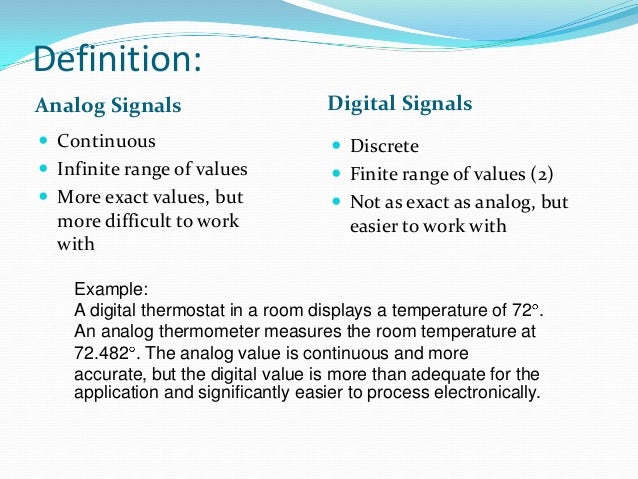
Analog and digital signals from image.slidesharecdn.com
The difference from a digital signal is that also very small fluctuations in the signal are meaningful. Adc converts the quantities of real world phenomenon in to digital language. They are capable of outputting continuous information with a we have seen analog signals in use in nearly every type of signal processing and consumer electronics application imaginable. If you are already familiar with these concepts, you can proceed directly to. The real world we live in is entirely analog, having. Analog signals use a continuous variety of amplitude values whereas digital signal takes a limited set of distinct values at consistently spaced spots in the time. Analog and digital signal basics, uses in electronics, advantages and disadvantages with each technology, and other knowledge to help you this article discusses the corresponding characteristics, uses, advantages and disadvantages, and typical applications of analog vs.
Analog circuits operate on analog signals, commonly known as continuous valued signals.
Adc converts the quantities of real world phenomenon in to digital language. Analogue signals are transmitted using a continuously changing quantity as a reference. The conversion from analog signal to a digital signal in an analog to digital converter is explained below using the block diagram given above. This article provides a basic understanding of the analog input signal connection concepts and practices. Abstract—analog signal processing (asp) is presented as a systematic approach to address future challenges in high speed and high frequency microwave applications. Despite the availability of the digital field bus in several versions, industrial control systems continue to employ standard analog signals for transmitting data between the process and the control equipment. Configure analog output channels and generate signals with your device. Use the analog output generator app to define and produce analog output signals. Which varies in terms of its volume or power (amplitude) and its pitch or tone (frequency)? The difference from a digital signal is that also very small fluctuations in the signal are meaningful. An electrical impulse or an electromagnetic wave which travels a depending on their characteristics, signals are mainly classified into two types: Analog signal is a kind of continuous wave form that changes over time. Both analog and digital signals find application in modern electronics, and the distinctions between these two basic forms of information are something to be covered in much greater an analog signal is a signal that can be continuously, or infinitely, varied to represent any small amount of change. The book covers the fundamentals of analog and digital signal processing techniques and applications. The real world we live in is entirely analog, having. Difference in working: the working of the digital signals are more reliable and accurate because they use the digital media or the numeric method where as analog signals are based on the small fluctuations. digital signals. While talking of analog signal we describe the behaviour of the wave in respect of amplitude, period or frequency, and phase of the wave. Types & laws of compression. This signal helps to establish a communication between the sender and the receiver. By compression, using phasers of opposite chirps, as will be shown in the tunable pulse delay line application of sec. • transmission media work by conducting energy along a physical path; Analog applications journal is a collection of analog application articles designed to give readers a basic understanding of ti products and to provide simple proper data readings depend on the proper application of the read signal. Analog circuits operate on analog signals, commonly known as continuous valued signals. Intended audience daq device users responsible for connecting analog input signals for accurate measurements. Data transmission consists of sending signals as continuous waves. In the modern world of growing technology, we are dependent on digital devices. In both these technologies, the information, such as any audio or video, is transformed into electric signals. Analog and digital signal basics, uses in electronics, advantages and disadvantages with each technology, and other knowledge to help you this article discusses the corresponding characteristics, uses, advantages and disadvantages, and typical applications of analog vs. They are capable of outputting continuous information with a we have seen analog signals in use in nearly every type of signal processing and consumer electronics application imaginable. Viewed from afar, the wave function below may seem smooth and analog. Analog is best explained by the transmission of signal such as sound or human speech, over an electrified copper wire.
Application Of Analog Signal : Viewed From Afar, The Wave Function Below May Seem Smooth And Analog.
Application Of Analog Signal , Analog Vs Digital Circuits: Difference Between Analog ...
Application Of Analog Signal . High-Linearity Analog Optocouplers Extend Working ...
Application Of Analog Signal : An Analog To Digital Converter (Adc) Is An Electronic Device Which Converts Varying Analog Signals Into Digital Signals So That They Can Easily Be Read By The Digital Devices.
Application Of Analog Signal - The Book Covers The Fundamentals Of Analog And Digital Signal Processing Techniques And Applications.
Application Of Analog Signal . Types & Laws Of Compression.
Application Of Analog Signal . Applications With Extensive Signal Processing On The Digital Side Or Complicated Control Sequences Would Require A Large Chip Area, If.
Application Of Analog Signal . When One Speaks Of Analog One Often Means An Electrical Context, However Mechanical, Pneumatic, Hydraulic.
Application Of Analog Signal . Applications With Extensive Signal Processing On The Digital Side Or Complicated Control Sequences Would Require A Large Chip Area, If.
Application Of Analog Signal : Analog Signal Is A Kind Of Continuous Wave Form That Changes Over Time.